Organization of Turkic States

Goals, Ambitions, or a New Like-Minded Bloc?
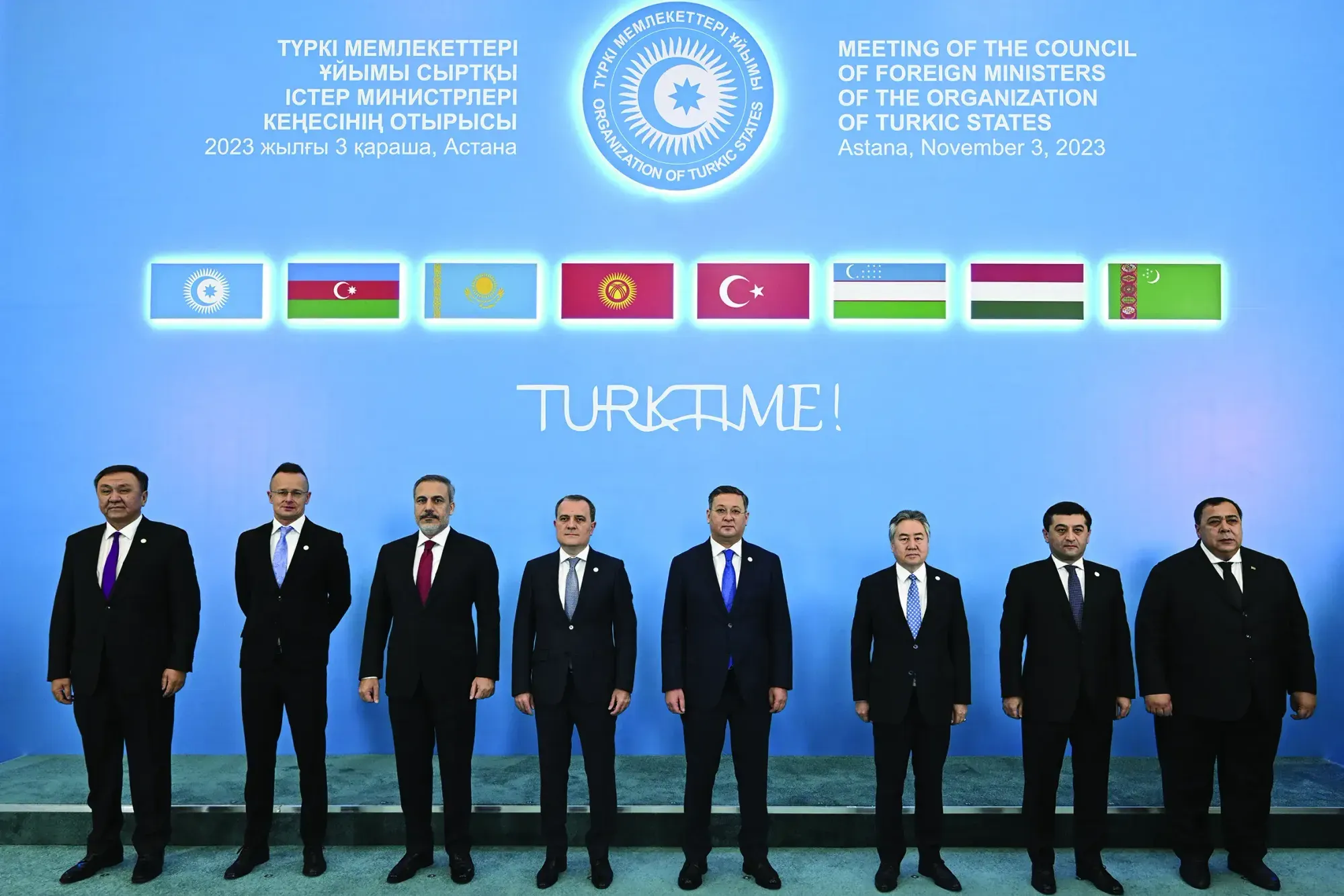
If you haven't heard of the Organization of Turkic States, you're not alone — it barely registers in Western news cycles. But over the last few years it's quietly become one of the more interesting experiments in regional cooperation happening anywhere in the world, and in 2026 it hit a genuinely strange moment: the same week Kazakhstan's president signed a "declaration of eternal friendship" with Turkey and a billion-dollar deal to build Turkish combat drones on Kazakh soil, he stood in front of the assembled leaders and ruled out the one thing that would actually worry Moscow, Beijing, and Tehran — a Turkic military alliance.
This piece walks through what the Organization of Turkic States actually is, where the idea behind it came from (it's over a century old), what's genuinely new about the current moment, what it would take for this to become something bigger — a real bloc, EU- or NATO-style — and, because it matters, an honest look at where the information in this piece comes from and what interests might be shaping it.
No prior knowledge required. Let's start from the beginning.
AUSkip navigationCreate9+Why There’s No Pan-Turkic Empire
What is the Organization of Turkic States?
"Turkic" refers to a family of related languages and the peoples who speak them, stretching from Turkey in the west across the Caucasus and Central Asia to parts of Siberia and western China. It's a linguistic and cultural category, not a single ethnicity or nation — Turks, Azerbaijanis, Kazakhs, Uzbeks, Kyrgyz, Turkmen, and several smaller groups all speak Turkic languages, with historical roots tracing back to nomadic peoples of the Central Asian steppe.
The Organization of Turkic States (OTS) is an intergovernmental organization of countries where Turkic languages are the majority or a major language. It was founded in modest form in 2009 in Nakhchivan (an Azerbaijani exclave), under the more limited name "Cooperation Council of Turkic-Speaking States." In November 2021, at a summit in Istanbul, it was relaunched with much greater ambition under its current name, with five full members:
- Turkey
- Azerbaijan
- Kazakhstan
- Kyrgyzstan
- Uzbekistan
Three more sit as observers: Turkmenistan, Hungary (whose historical connection to the Turkic world runs through a related but distinct ideology called Turanism, explained below), and the Turkish Republic of Northern Cyprus (a state recognized only by Turkey itself — this detail becomes important later).
At the 2021 relaunch, members adopted something called the "Turkic World Vision 2040," a long-term roadmap for cooperation. Since then the organization has built out real institutional plumbing: a joint investment fund, a Common Alphabet Commission working to align the different Turkic languages' writing systems, and a growing web of parliamentary, educational, and media cooperation platforms.
None of that, on its own, is remarkable — plenty of regional organizations have investment funds and cultural commissions. What's made the OTS a genuine subject of geopolitical debate is what's happened alongside it: a rapidly deepening defense relationship, increasingly bold political rhetoric from some members, and real alarm in Moscow, Tehran, and parts of the European press about where it might be heading. To understand why, you have to go back much further than 2021 — because almost everything happening today is a rerun of an argument Turkey and its neighbors have had twice before.
A hundred-year-old idea: Pan-Turkism and Turanism
Most coverage of this topic — and most casual conversation about it — treats "Pan-Turkism" and "Turanism" as interchangeable. They aren't, and the difference actually explains a lot about how the OTS is structured today.
Pan-Turkism grew out of the late Ottoman Empire's response to imperial decline in the late 19th and early 20th centuries. This was the era of "pan-ideologies" generally — Pan-Slavism was shaping Russian imperial policy, Pan-Germanism was shaping the German and Austro-Hungarian world, and Pan-Italian sentiment had just helped unify Italy in 1870. Young Turk officers and intellectuals, many educated in Europe, watched these movements consolidate rival states and built a parallel project for the Ottoman world: a shared Turkic identity that could unify society, modernize the empire, and extend its influence into the Caucasus and Central Asia.
It didn't go smoothly. Elevating Turkish identity as a state project alienated the empire's non-Turkish populations — Arabs and Armenians especially — and helped trigger the nationalist movements that eventually broke the empire apart (the Young Arab Society, one of the earliest organized Arab nationalist groups, was founded in Paris in 1909 partly in reaction to this).
Turanism is a related but separate idea, and it didn't even start in Ottoman political thought. It came from Finno-Ugric linguistic scholarship being done in the Russian Empire — a scholar named Mátyás (Matias) Alexander Castrén researched supposed connections between Turkic, Mongolic, and Finno-Ugric peoples under a broader "Ural-Altaic" umbrella. This expansive vision — a "Turan" homeland uniting Turks, Mongols, Finns, and Hungarians — was institutionalized in a Turan Society founded in Budapest in 1910. It's a much bigger, vaguer, more mythologized idea than Pan-Turkism, and its scientific basis (shared descent among all these peoples) has long since been discredited.
The key figure who narrowed things down was Ziya Gökalp, the principal Ottoman theorist of Turkism. In his work The Principles of Turkism, he explicitly rejected the broader Turanist scope — deliberately excluding Hungarians and Finns — and confined the concept strictly to Turkic peoples. That divergence between Gökalp's narrow, ethnolinguistic frame and the older, broader civilizational Turanism is the root of a lot of confusion in modern commentary. When people worry about a "Turanic empire stretching across Eurasia," they're usually invoking the older, broader vocabulary. When they talk about the OTS specifically, they're really talking about Gökalp's narrower frame — which is exactly what today's organization is built on. Its membership criterion is Turkic linguistic and cultural identity, full stop; Hungary's observer status is the only real institutional nod to the older, broader Turanism, and even that is symbolic rather than structural.
When this idea was genuinely dangerous
It's worth remembering that this ideology hit a real ceiling once already, with real power behind it — which is exactly why Turkey's post-Ottoman founders treated it as politically radioactive for most of the 20th century.
Enver Pasha, one of the Ottoman Empire's key WWI-era leaders, used Turanist ambition to help justify the empire's entry into the First World War, hoping to fold the Caucasus and Central Asia into a Turkic-led sphere. In the following decades, radical figures like Nihal Atsız built an exclusionary, enemies-list version of Turkish ethnic nationalism, identifying communists, Jews, Persians, and Russians as civilizational enemies — a strand of extremist nationalism that had disturbing echoes elsewhere in the region during the same period.
After Germany's defeat at Stalingrad in 1943, Ankara — wary of provoking Soviet retaliation — moved against its own Pan-Turkist networks. The 1944–45 "Racism-Turanism trials" saw prominent Pan-Turkist figures, Atsız among them, arrested and prosecuted (many convictions were later overturned on appeal, but the political signal was unmistakable). Modern Turkey's founder, Mustafa Kemal Atatürk, deliberately built an inward-facing "state nationalism" confined to Turkey's own republican borders, specifically to avoid antagonizing the Soviet Union next door.
For the rest of the Cold War, Pan-Turkist currents in Turkey — including the nationalist paramilitary movement known as the Grey Wolves — were tolerated domestically as anti-communist muscle, used in street confrontations and to suppress leftist unrest, but were never permitted any meaningful cross-border political role. Even Alparslan Türkeş, founder of the Grey Wolves and of Turkey's Nationalist Movement Party (the MHP — a name that will come up repeatedly later in this piece), described the doctrine in explicitly self-restraining terms: while every Turk had the right to support Turks living under foreign rule, he insisted it was essential to stay realistic and never let Turkish nationalism become a path that leads Turkey into real danger. In its mainstream Turkish form, Pan-Turkism was never a serious project to redraw borders.
The 1990s dress rehearsal
The pattern playing out today already happened once before, and it's worth knowing because the outcome was instructive.
When the Soviet Union collapsed in 1991, five new Turkic-speaking republics appeared on Turkey's doorstep for the first time in a century — Azerbaijan, Kazakhstan, Kyrgyzstan, Turkmenistan, and Uzbekistan. Turkey moved in fast. Ankara was the first country to recognize their independence. Under President Turgut Özal, Turkey sent over 1,170 official delegations to the region in the first year of independence alone, signing more than 140 bilateral cooperation agreements by 1993. Özal himself died that year, worn out by an exhausting diplomatic tour of Central Asia. His successor, Süleyman Demirel, spoke expansively of a Turkic world stretching "from the Adriatic to the Great Wall of China."
The response from the newly independent capitals was cautious from the start, and the logic was simple: these were states that had just spent seventy years under Moscow's thumb and had zero appetite to swap a Russian "elder brother" for a Turkish one. Cultural and linguistic kinship did not translate into political deference.
Azerbaijan actually tried the fuller version of this project. Under President Abulfaz Elchibey, Baku briefly attempted to translate Pan-Turkist rhetoric directly into state policy — and it went badly. Azerbaijan's defeat in the first war with Armenia over Nagorno-Karabakh, combined with the diplomatic friction his positioning caused with Iran and other neighbors, collapsed his authority within about two years. Uzbekistan's President Islam Karimov broke relations with Baku entirely after Azerbaijan granted political asylum to some of his opponents.
Within Turkey itself, Pan-Turkism never really escaped the political margins during this period either — the dominant national project of the 1990s and early 2000s was integration with the European Union, not Central Asia. And Turkey's own mid-1990s political instability and currency crises limited what Ankara could realistically offer the region even when it tried. As one Turan Research Center analysis put it: Turkey lacked the financial capacity to compete with the US, China, the EU, or Russia for influence — a constraint that, as we'll see, hasn't really gone away.
That exact hedging instinct — three decades dormant — is precisely what Kazakhstan's president voiced again in May 2026, almost word for word.
Erdogan's real ideology (it's not what you'd assume)
It's a common assumption that Recep Tayyip Erdogan is a committed Pan-Turkist. He isn't, by background or instinct — he's much more accurately described as a Pan-Islamist, and understanding that distinction matters for reading everything that follows.
Through the 2000s and early 2010s, Erdogan's foreign policy ran through Foreign Minister Ahmet Davutoğlu's "zero problems with neighbors" doctrine, which prioritized deep engagement with the Arab and broader Muslim world, not Central Asia. The high point came in 2011, during the Arab Spring — Erdogan's reception in Cairo after the fall of Hosni Mubarak wasn't just diplomatic theater; for a moment, Turkey genuinely looked positioned to lead a new political order across the Arab world, and his model — combining electoral legitimacy, economic growth, and Islamic identity — was openly embraced by movements in Tunisia and Egypt.
That window closed fast. The rise of a Turkey-Qatar alignment triggered pushback from Saudi Arabia and the UAE, who saw Ankara's growing influence and its association with the Muslim Brotherhood as a direct threat. The decisive break came with Egypt's 2013 coup, which removed Erdogan's ally Mohamed Morsi from power and effectively rolled back Turkey's post-Arab Spring ambitions. Turkey's deepening entanglement in the Syrian civil war added a prolonged security crisis on top of it, and domestic political pressure started mounting at home.
This is the moment that actually shapes everything that follows: Erdogan entered a pragmatic political alliance with Devlet Bahçeli, leader of the nationalist MHP — the same party once led by Alparslan Türkeş — to shore up his political position. It's from roughly this point in the mid-2010s that Pan-Turkic language starts entering Erdogan's speeches in a sustained way. Not because Ankara adopted a new grand doctrine, but because the Middle Eastern project had stalled and the Turkish nationalist constituency had become politically indispensable. Pan-Turkism didn't replace Erdogan's Pan-Islamism — it joined it, as a second, equally flexible instrument, deployed wherever it's useful, while his underlying engagement with Hamas, Gaza, and the wider Muslim world has stayed the constant thread of his actual worldview.
This matters for everything that follows in this piece: the MHP alliance is the load-bearing wall under the current wave of Pan-Turkic rhetoric. It was never rooted in fixed ideological commitment. It's a coalition-management tool. And coalition-management tools change when the coalition's needs change — which is exactly what's happening as this piece goes to press, in a way that fundamentally complicates the "new bloc" story.
What's actually new since 2021
So against that hundred-year backdrop of tried-and-abandoned Pan-Turkic projects, what's genuinely different about the current moment?
First, the regional military balance actually shifted. Turkish-made drones — specifically the Bayraktar TB2 — proved decisive in Azerbaijan's victory over Armenia in the 2020 Nagorno-Karabakh war, reframing Turkey almost overnight from a rhetorical patron of Azerbaijan into a material military guarantor. That relationship has since deepened and extended to Kazakhstan and Uzbekistan as well.
Second, the institutional architecture has genuinely thickened. The OTS's joint investment fund is operating. The Common Alphabet Commission is doing real work. Parliamentary, educational, and media cooperation platforms have multiplied. None of this constitutes "integration" in the EU sense — there's no shared market, no supranational authority, no binding political commitments — but the cumulative density of cooperation is higher than at any point since 1991.
Third, the geopolitical environment around the region has shifted. Russia's war in Ukraine has visibly weakened Moscow's grip on Central Asia and the South Caucasus, its traditional sphere of influence, opening space for other partners. China remains the dominant economic actor in the region through Belt and Road infrastructure financing, but its presence there is principally commercial, not political or cultural. Turkey is positioned to offer something neither Russia nor China does: a shared cultural and linguistic frame, defense-industrial cooperation, and an explicit invitation into a common political identity.
The most concrete recent step: in May 2026, at a summit in Astana/Turkistan, Kazakhstan became the first country outside Turkey licensed to produce the ANKA combat drone — a deal with Turkish Aerospace Industries covering joint manufacture, maintenance, and full technology transfer. Turkey followed this up with EFES 2026, its largest-ever combined live-fire military exercise, held in İzmir with over 10,000 troops and observers from 50 nations, showcasing everything from the TCG Anadolu amphibious assault ship to domestically-built patrol boats and drone strikes launched directly from ship decks.
The rhetoric has kept pace with the hardware. At the 2021 Istanbul summit, Bahçeli — the MHP leader whose earlier restraint we covered above — handed Erdogan a map depicting a "Turan World" stretching from the Balkans to East Asia. Erdogan accepted it, and has since spoken publicly about a possible "Turan Army." Azerbaijan's President Ilham Aliyev has gone further still, arguing the Turkic world's boundaries extend beyond formal OTS membership to ethnic kin living in other countries entirely. Turkey's own deputy foreign minister, Burhanettin Duran, has argued Ankara should adopt an active "balancing role" in the region specifically to prevent China from dealing with the Turkic world the way it has with Africa — a striking admission that Turkish officials themselves see this partly as a competition with Beijing for regional influence.
That combination — real institutions, real drone deals, and genuinely imperial-sounding rhetoric — is exactly what generates the "new bloc" headlines. But there's a wall standing directly in front of all of it, and it was put there by the country the entire project needs most.
The wall: what Kazakhstan actually did
This is the pivot point of the whole story.
At an informal OTS summit in Turkistan (a historic city in southern Kazakhstan) on May 15, 2026, President Kassym-Jomart Tokayev signed a "Declaration of Eternal Friendship and Expanded Strategic Partnership" with Erdogan, alongside the ANKA drone production deal described above. He called deepening Turkic unity a critical and urgent priority. Then, in the same speech, with Erdogan sitting in the room, he addressed the growing talk of a military alliance directly and killed it:
"The Organization of Turkic States is not a geopolitical project or a military organization."
He went further, describing those pushing the "military alliance" framing as having intentions that had "nothing to do with reconciliation" — a pointed line aimed as much at outside actors stoking alarm as at anyone inside the organization itself. The summit's actual headline theme reinforced the point: not a Turan Army, but "Artificial Intelligence and Digital Development." Kazakhstan, per reporting from The Diplomat, wants the Turkic world functioning as a tech and trade hub — not a security bloc — consistent with Astana's decades-long "multi-vector" foreign policy of carefully balancing Russia, China, Turkey, and the West all at once, rather than binding itself to any single patron.
The single strongest piece of evidence that this isn't just diplomatic theater came almost a year earlier, and had nothing directly to do with Turkey. At the first-ever EU–Central Asia summit, held in Samarkand in April 2025, all five Central Asian states — Kazakhstan, Uzbekistan, Kyrgyzstan, Tajikistan, and Turkmenistan — signed a joint statement reaffirming UN Security Council Resolutions 541 and 550, which refuse international recognition to the Turkish Republic of Northern Cyprus — an OTS observer state that only Turkey itself recognizes as sovereign. Forced to choose, in writing, between European diplomatic norms and solidarity with their "brotherly" Turkic partner on a core Turkish territorial claim, Central Asia sided with Europe. That's a considerably harder signal than anything said at a summit podium.
Underneath all of this sits a blunt structural constraint: Turkey's own economy, under sustained inflationary pressure and currency volatility, simply doesn't have the balance sheet to outbid Chinese Belt-and-Road financing or Russian energy and labor-market leverage in Central Asia. Defense exports and cultural programs are real instruments of influence — they're not, on their own, sufficient to reorient the fundamental strategic calculus of Central Asian capitals. Former Kyrgyz politician Bakyt Beshimov put the underlying skepticism more bluntly than most professional analysts are willing to: the idea of a united Turkic world, he's argued, is about the past, not the future — and even in the past, Turkic peoples spent plenty of time fighting each other.
So what does the current state actually mean for the "old powers"?
Pulling this together as of mid-2026:
- This is not a rival alliance structure today. No OTS member has signed anything resembling a mutual-defense clause with Turkey at the center, and Kazakhstan and Uzbekistan have said so, publicly and repeatedly, on the record.
- The defense-industrial shift is real regardless. Central Asian states building indigenous drone production capacity on Turkish technology transfer is a genuine, structural change away from dependence on Russian-legacy hardware — even without any formal alliance attached to it.
- Russia's weakness is doing more work than Turkish strength. Moscow's military and diplomatic bandwidth is consumed by Ukraine. That's opening space Turkey is filling opportunistically — evidence that Russia has temporarily vacated ground, more than evidence Ankara has out-competed it.
- China isn't remotely threatened by any of this. Beijing's leverage in the region runs through infrastructure finance and the Shanghai Cooperation Organization (SCO) — a completely different lane from Turkic cultural and defense diplomacy, and one Turkic cooperation doesn't meaningfully crowd out.
- Turkey's own NATO membership remains the more consequential variable for the West. Ankara still relies on NATO air defense infrastructure — as demonstrated when NATO systems intercepted Iranian ballistic missiles over Turkish airspace multiple times during 2026 — which cuts hard against any reading of the OTS as Turkey building an independent security architecture to replace, rather than supplement, its NATO ties.
That's where things stand right now. But "right now" isn't the whole question — and this is where it gets genuinely interesting.
What if they actually pull it off?
Here's the scenario worth taking seriously: what if the Organization of Turkic States does eventually become a real, binding bloc — something structurally comparable to the EU or NATO, with actual mutual obligations, not just friendship declarations? What would that take, and — critically — what direction would it actually point in?
What "pulling it off" structurally requires
Neither the EU nor NATO were built on shared culture and friendly summits. Both required things the OTS currently lacks entirely:
- A binding mutual-obligation clause — NATO's Article 5 commitment to collective defense, or the EU's progressive transfer of real sovereign decision-making to supranational institutions.
- A forcing threat every member agrees is existential — for NATO, Soviet tanks on the other side of the Elbe. For the EU's founding steps, the trauma of two wars that had just killed tens of millions of Europeans.
- A financial anchor bigger than any single member can walk away from — the EU's single market and structural funds; NATO's US-backed nuclear umbrella and defense-industrial base.
- Enforcement mechanisms that survive a member's government changing its mind — durable institutions, not arrangements that unwind the moment one country's domestic politics shift.
The OTS currently has none of these four things. It has a shared linguistic-cultural membership test, a modest investment fund, bilateral (not collective) defense deals, and — this is the crucial missing piece — no shared enemy that all five members agree is existential. Kazakhstan and Uzbekistan simply don't view Russia the way West Germany viewed the USSR in 1955. They see a weakened but still-necessary neighbor they need to keep doing business and diplomacy with, which is exactly why Tokayev keeps capping the relationship in public.
The finding that changes the shape of this question entirely
Here's the piece of reporting that complicates the "new bloc neutralizes the old powers" framing more than anything else in this whole story: the same Turkish political movement that started the current wave of Pan-Turkic enthusiasm has, as of 2026, walked back from it.
Bahçeli's MHP — the party whose leader physically handed Erdogan the "Turan World" map at the 2021 summit that kicked off this entire chapter — sent its deputy chairman, İlyas Topsakal, to Moscow in March 2026 on Bahçeli's direct instructions. In an interview with the Russian newspaper Vedomosti, Topsakal described the MHP's historic Pan-Turkist vision of the post-Soviet space as "romantic" and "no longer relevant." What he pitched instead, in meetings with Russian political figures, bureaucrats, and intellectuals, was a proposed Turkey-Russia-China axis — explicit "synergy" between the Shanghai Cooperation Organization (SCO), the Collective Security Treaty Organization (CSTO), the Commonwealth of Independent States (CIS), and the OTS itself.
This is corroborated across multiple mainstream Turkish outlets, not just Russian media (Daily Sabah and Türkiye Today both covered it independently). Bahçeli had already floated the underlying idea in September 2025, calling for a Turkey-Russia-China strategic alliance to counter what he termed a "U.S.-Israel evil coalition," and later expanded it into a proposed "World Peace Council" including Turkey, the US, Russia, and the EU. Topsakal made the political stakes explicit: the MHP's price for staying in Erdogan's governing coalition through the 2028 election isn't cabinet seats — it's Ankara formally adopting a cooperation program with Moscow and Beijing.
Why is this happening now? Turkish strategic circles have grown genuinely uncertain about the reliability of NATO's Article 5 commitment, given repeated statements from the Trump administration questioning US commitment to the alliance. Layered on top is rising Turkish anger at Israel — deepening Israeli military and intelligence cooperation with the Republic of Cyprus, Israeli use of Cypriot airspace, and a broader sense in Ankara that in any hypothetical Turkey-Israel confrontation, Washington would side with Israel.
This matters enormously for the "what if." If the OTS ever does harden into something with real teeth, the strongest live domestic political force pushing toward that outcome right now isn't pushing it toward "neutralizing Russia and China." It's pushing it toward folding the Turkic world into synergy with Russia and China, against the West and Israel — close to the mirror image of the scenario originally worth worrying about.
The realistic spread of scenarios
- Most likely, near-term: continuation of the current hedge. Deeper bilateral defense-industrial ties, thicker cultural and institutional architecture, no binding alliance of any kind, Central Asia continuing to do business with everyone simultaneously. This is where the actual evidence currently sits.
- Aliyev's vision — a genuine Turkic-only defense bloc. This would require Kazakhstan and Uzbekistan to reverse course entirely, which the Samarkand vote and Tokayev's repeated public rejections argue strongly against — barring a shock that hits multiple Turkic states simultaneously (a direct Iranian or extremist strike spreading beyond Azerbaijan and Turkey is not a purely hypothetical risk, given the missile interceptions already occurring over Turkish airspace in 2026).
- The MHP/Bahçeli vision — a Turkic-Russian-Chinese "Eurasian synergy." Live and gaining real momentum, specifically because of NATO-reliability doubts and Israel-related friction, contingent on Erdogan needing MHP's parliamentary votes through 2028. This would not "neutralize" the old powers in the sense originally proposed — it would functionally re-subordinate part of Ankara's regional project to two of them.
- Quiet fragmentation. Turkey and Azerbaijan continue deepening bilaterally — their relationship already resembles something closer to an alliance than anything OTS-wide — while Kazakhstan and Uzbekistan keep treating the wider OTS purely as a trade and technology platform.
None of these plausible paths delivers the original scenario of an Ankara-anchored bloc strong enough to check Russia, China, and the West simultaneously. The versions that involve genuine hardening either point toward Moscow and Beijing rather than away from them, or stay confined to the Turkey-Azerbaijan axis rather than spreading across the wider membership.
Total transparency: who's actually telling you all of this?
Given how much of this piece rests on one particular explainer video and the analysis behind it, it's worth being completely upfront about where the information comes from and what interests, if any, might be shaping how it's framed. "Research center" is a label anyone can put on a website — Washington, DC has hundreds of them, with wildly different levels of genuine independence.
The primary source
Much of the historical framing in this piece is drawn from a video published by the Turan Research Center, a program hosted at the Yorktown Institute, titled "Eternal Friendship — But No Alliance" (published June 15, 2026), hosted by journalist Bruce Pannier, and based on written analysis by political scientist Rafael Sattarov. Everything else in this piece is drawn from independent news reporting, cross-checked against that source.
Bruce Pannier — solid, on his own track record
Pannier spent over 25 years as RFE/RL's (Radio Free Europe/Radio Liberty) Central Asia correspondent. RFE/RL is a US Congress-funded international broadcaster (via the US Agency for Global Media), historically a Cold War-era soft-power outlet, but by now widely regarded within the field as serious, on-the-ground regional journalism — the kind that frequently irritates the governments it covers. He's also a Central Asia fellow at the Foreign Policy Research Institute and sits on advisory boards for the Caspian Policy Center and European Neighborhood Council. His specific factual claims — the Tokayev quotes, the drone-deal terms, the 1990s history — all check out cleanly against independent reporting from outlets with no institutional connection to Yorktown. His personal credibility on the region's facts and history is strong and predates his newer affiliation with the Turan Research Center.
Rafael Sattarov — independent, long track record
An Uzbek political analyst with degrees from Tashkent's University of World Economy and Diplomacy and Moscow's Higher School of Economics, Sattarov has over a decade of published analysis with Carnegie Endowment for International Peace, CABAR.asia, and Forbes Russia, and is an alumnus of NATO's Young Leaders program. His underlying written research is what the video is based on. Independently credible, though the NATO program line is worth noting as one data point among several — a soft prior institutional touchpoint, not a disqualifying one.
Yorktown Institute — the parent organization, and where it leans
Founded in 2022 by Seth Cropsey — a Reagan/Bush-era Pentagon and Navy official, later a long-serving senior fellow at the Hudson Institute (a well-known, historically hawkish/neoconservative Washington think tank with a track record of defense-industry-linked funding). Cropsey's own writing sits squarely in the "great power competition" hawk lane — pro-NATO expansion, pro-defense spending, skeptical of European "weakness," focused on countering both China and Russia. A left-leaning watchdog site, Militarist Monitor (run by the Center for International Policy, itself not a neutral source and worth flagging in the other direction), characterizes him as a career neoconservative. Yorktown Institute does not appear to publicly disclose its donor list; its Charity Navigator and IRS filings describe its activities in detail but not its funders, which is common for a think tank this size but does mean the funding behind the analysis can't be independently verified. (Worth noting: don't confuse it with the separate, unrelated "Yorktown Foundation for Public Policy," a Virginia state-policy nonprofit with a different founder and focus — an unfortunate naming coincidence.)
Joseph Epstein, Turan Research Center Director — the most relevant disclosed interest
This is the detail most worth sitting with. Joseph Epstein, the Center's director, served from 2017 to 2019 in the Israeli Border Police as a "Lone Soldier" (a foreign volunteer), is a research fellow at Bar-Ilan University's Begin-Sadat Center for Strategic Studies (an academically respected but generally security-hawk, Likud-adjacent Israeli think tank), and is affiliated with the N7 Foundation, whose explicit mission is deepening the Abraham Accords — Israel's diplomatic normalization with Arab and Muslim-majority states — funded in part by the Charles and Lynn Schusterman Family Philanthropies and the Jeffrey M. Talpins Foundation. He writes regularly for JNS (Jewish News Syndicate, an explicitly pro-Israel outlet) and Newsweek, and has publicly described the Azerbaijan-Israel relationship as "a model that should inspire Israel's relations across the Muslim world."
None of that makes him dishonest, and it doesn't mean any specific fact in this piece is wrong. But it is a clear, disclosed set of professional and personal interests: Epstein has real reasons to want the story of Turkic-world diplomacy to read as integration-friendly — good for Azerbaijan-Israel ties, reassuring to a Western and Israel-aligned audience — rather than as evidence of a bloc potentially drifting toward Moscow and Beijing. That's exactly the frame the source video lands on: "relax, this is theater, not substance." The Samarkand UNSC vote and Tokayev's own on-record words are hard evidence, not spin, so the frame isn't wrong on the current facts — but it's a reason to want the interpretation independently corroborated, which, on the specific factual claims, it mostly is (Astana Times, The Diplomat, RANE/Stratfor, Daily Sabah, and Türkiye Today are all editorially independent of Yorktown and report the same underlying events).
The opposite direction, for balance — and it's worse
While researching the "OTS as covert NATO encirclement of Russia and China" framing that circulates in some corners, this research ran into sources making exactly that argument. The most prominent, Global Research (globalresearch.ca), is a Canadian outlet with a well-documented history of publishing conspiracy content and material aligned with Russian state narratives; it should not be treated as a reliable source on this or most other geopolitical topics. A Russian outlet covering the MHP-Moscow story carried its own obvious interest in framing Turkic cooperation as a cracking Western plot. These are flagged not because their specific factual claims are necessarily false, but because they're propaganda-adjacent from the opposite direction and deserve at least the scrutiny applied to Yorktown above.
Bottom line on sourcing
Trust the checkable facts in this piece — the Tokayev quotes, the Samarkand vote, the drone-production numbers, the Topsakal/MHP-Moscow story — because they're independently corroborated across outlets with no shared institutional interest. Hold the interpretive conclusion ("no empire, nothing to worry about, for now") a little more loosely, specifically because it comes from a shop whose director has a disclosed personal and professional stake in that being the reassuring answer, and whose parent institute's entire mission is keeping Turkey anchored to NATO rather than watching it hedge toward Moscow and Beijing. The facts hold up well. The frame is worth holding a little more loosely — and the MHP-Moscow story is exactly the kind of development that frame would be slowest to weight heavily, because it cuts against the "nothing to see here" conclusion far more than a Central Asian hedge does.
What to watch going forward
- Whether Azerbaijan's proposed 2026 joint OTS military exercises actually take place, and at what scale.
- Whether the OTS investment fund grows large enough to matter alongside Chinese or Russian financing in the region.
- Hungary's role — Viktor Orbán is the most ideologically committed non-Turkic participant, and his own domestic political turbulence could affect that engagement.
- Russia's trajectory in Central Asia — if Moscow's position keeps eroding, the space available to Ankara expands; if Russia stabilizes its regional posture, that space contracts again.
- Erdogan's domestic coalition — specifically, how much further the MHP's push for a Turkey-Russia-China cooperation program advances ahead of the 2028 Turkish elections, and whether Erdogan actually accommodates it.
- Whether Uzbekistan — currently the most cautious full member — shifts its own defense-industrial posture toward Turkey the way Kazakhstan already has.
Bottom line
The institutional architecture, the drone deals, the century-old rhetoric revived for a new era — all of it is real, and the region is more densely connected than at any point since the Soviet collapse. But the idea that this is currently hardening into something capable of "neutralizing" the established powers doesn't hold up against the evidence: Central Asia's own governments have said no, repeatedly and specifically, including in ways that carry real diplomatic cost (siding with Europe over Turkey on Cyprus). What's actually happening looks less like Cairo in 2011, where Erdogan briefly looked poised to lead a new regional order, and more like a venue where Ankara is welcomed, listened to, and quietly hedged against by partners simultaneously doing business with Moscow, Beijing, and Brussels all at once.
And if that changes — if this does eventually harden into something with real teeth — the most credible political force pushing for that outcome right now, inside Turkey's own governing coalition, is aimed at Moscow and Beijing as partners, not as targets. Whether any of this becomes durable depends far less on the rhetoric coming out of Turkic-world summits than on two much more mundane variables: how much longer Russia stays distracted by Ukraine, and how long Erdogan's domestic coalition arithmetic holds together on its current terms.
References
Primary source
- Turan Research Center / Yorktown Institute, "Eternal Friendship — But No Alliance" (YouTube, June 15, 2026) — youtube.com/watch?v=f5BAILfoQKo
- Rafael Sattarov, "The Evolution of Pan-Turkism and Turanism: From Intellectual 'Pan-ideologies' to Türkiye's Political Toolkit," Turan Research Center / Caspianpost — caspianpost.com
Background and current state of the OTS
- Brookings, "Turkey's search for a Middle East order" — brookings.edu
- CSIS, "Strategic Ambiguity: Erdoğan's Turkey in a Multipolar World" — csis.org
- Middle East Institute, "Turkish Foreign Policy" — mei.edu
- USNI News, "Ankara's Ambition" — news.usni.org
- Türkiye Today, "EFES 2026 puts Türkiye's defense power on display as 50 nations join drills" — turkiyetoday.com
- Wikipedia, "2026 in Turkey" and "2026 interceptions of Iranian missiles in Turkey"
Defense cooperation and military drills
- Daily Sabah, "Aliyev proposes 2026 joint military drills of Turkic states" — dailysabah.com
- Anadolu Agency, "Azerbaijan proposes joint military drills among members of Organization of Turkic States in 2026" — aa.com.tr
- Hungarian Conservative, "Emerging Defence Cooperation Between Turkic States in the Shadow of Military Conflicts" — hungarianconservative.com
- Central Asia-Caucasus Institute & Silk Road Studies Program, "The Rise of the Organization of Turkic States" — silkroadstudies.org
- Aze.Media, "The rise of security and military cooperation among Turkic states" — aze.media
- Eastern Herald, "Turkey and Azerbaijan Showcase Expanding Military Alliance at EFES-2026" — easternherald.com
The ANKA drone production deal
- Nordic Monitor, "Turkey expands drone footprint in Central Asia with joint production deal" — nordicmonitor.com
- Xinhua, "Kazakhstan, Türkiye sign deal on joint drone production" — english.news.cn
- Daily Sabah, "Erdoğan touts strong co-op as Türkiye, Kazakhstan to jointly build drones" — dailysabah.com
- Asia Plus, "Kazakh, Turkish authorities agree to produce ANKA drones at joint venture in Kazakhstan" — asiaplus.news
Tokayev's rejection of a military alliance
- Kazakhstan Today, "Tokayev rejects idea of military alliance of Turkic states" — kt.kz
- bne IntelliNews, "Kazakhstan rejects idea of Turkic states military alliance" — intellinews.com
- Astana Times, "Tokayev Urges Greater Turkic Cooperation as Global Uncertainty Grows" — astanatimes.com
- Kursiv Media, "No 'Turkic NATO': Tokayev opposes a military alliance for the OTS" — kz.kursiv.media
- The Diplomat, "Why Kazakhstan Wants the Turkic World to Be a Tech Hub, Not a Military Bloc" — thediplomat.com
- The Diplomat, "Kazakhstan's Turkic Relations Between Trade, Culture, and Defense" — thediplomat.com
- RANE/Stratfor Worldview, "Kazakhstan: Tokayev Says OTS Is Not a Military Bloc as Turkic Ties Deepen" — worldview.stratfor.com
Pan-Turkism and Turanism history
- Berna Pekesen, "Pan-Turkism," European History Online (EGO) — ieg-ego.eu
- Encyclopedia.com, "Pan-Turanism" and "Pan-turkism"
- OSW Centre for Eastern Studies, "On the trail of the grey wolf: pan-Turkism in Turkey's foreign policy" — osw.waw.pl
The MHP, Bahçeli, and the Turkey-Russia-China axis
- Türkiye Today, "Erdogan's nationalist ally proposes 'World Peace Council' with Türkiye, US, Russia and EU" — turkiyetoday.com
- Türkiye Today, "Turkish gov't ally pushes for Türkiye-Russia-China alliance during Moscow visit" — turkiyetoday.com
- Türkiye Today, "Turkish gov't ally's push for Türkiye-Russia-China alliance matters more than ever now" — turkiyetoday.com
- Daily Sabah, "Türkiye-Russia-China alliance under spotlight after MHP's move" — dailysabah.com
- EUalive, "Is the Israel-U.S. campaign against Iran driving Turkey into Russian and Chinese arms?" — eualive.net
Source transparency: Yorktown Institute, Turan Research Center, and affiliated individuals
- Yorktown Institute, fellow and director bios (Bruce Pannier, Seth Cropsey, Joseph Epstein) — yorktowninstitute.org
- Turan Research Center, "About Us" and Joseph Epstein bio — turancenter.org
- Militarist Monitor, "Seth Cropsey" profile — militarist-monitor.org
- Hudson Institute, Seth Cropsey bio — hudson.org
- N7 Foundation, "About" — n7.org
- Carnegie Endowment for International Peace, Rafael Sattarov author page — carnegieendowment.org
- CABAR.asia, Rafael Sattarov author archive — cabar.asia
- Central Asia Program, Rafael Sattarov contributor bio — centralasiaprogram.org
Note on sources not used as evidence but flagged for balance: Global Research (globalresearch.ca) and a Russian outlet (english.realtribune.ru) both promote a competing "OTS as covert NATO encirclement" narrative. Neither is treated as a reliable source in this piece; they're mentioned above only in the interest of full transparency about the range of framings in circulation on this topic.
This is an AI generated post based on an article in my RSS feed. I was geninuely interested. I can already see mistakes in the AI "intelligence" but none that duly affect the outcome of the post.
This post was generated within 15 minutes based on the video link supplied, my questions and and possible "strategic" consequences. It is as enlightening for me as for you.
#enoughsaid