What's Really in the Price of Petrol


Disclaimer: This piece is an AI generated, based on parameters given by the author. It is not a political statement but the result of a genuine want by the author to understand what is happening based on science and facts, as determined by the AI which was given a broad scope, blew my daily token credits out the window and no word count limit.
Australian Fuel Prices, Pre-COVID to 2026
Every time petrol prices jump, two things happen almost simultaneously. Motorists start swearing at the bowser, and a government minister goes on television to explain that it isn't really their fault — it's crude oil, or the war in [wherever], or "international factors." Sometimes that's entirely true. Sometimes it's a convenient way to avoid talking about the roughly 40–50 cents in every dollar that goes straight to tax.
This piece pulls apart six years of Australian fuel prices — from the last "normal" year before COVID-19, through the pandemic crash, the 2022 Ukraine-driven spike, the quiet-ish 2023–25 period, and the extraordinary 2026 Middle East fuel shock that is still working its way through the system as this is written. It covers all eight capital cities, not just the five the Australian Competition and Consumer Commission (ACCC) usually headlines. It looks at what the fuel excise actually does, what the Singapore benchmark actually is, what governments have actually offered by way of relief, and — the part most coverage skips — how what governments said would happen compares with what the data shows did happen.
A note on sources before we start: fuel pricing in Australia is unusually well documented. The ACCC has published quarterly (and during 2026, weekly) petrol monitoring reports since 2007, and its data underpins most of the numbers below. Where I've drawn on economic commentary or political claims, I've tried to be explicit about who is saying it and what they stand to gain or lose from the framing — a Treasurer defending a $2.55 billion policy is a different kind of source to the Grattan Institute or Parliamentary Budget Office assessing it after the fact. A full reference list, grouped by source type, sits at the end.
1. How an Australian petrol price is actually built
Before the year-by-year story, it's worth being clear on the mechanics, because almost every political argument about petrol prices trades on people not knowing this.
Australia does not set its own petrol price. Since the 1970s, wholesale fuel here has been priced on import parity pricing (IPP) — domestic refiners and importers price fuel as if they were importing it, using the relevant Asian benchmark, even when it's actually refined locally. The specific benchmarks are:
- Singapore Mogas 95 Unleaded ("Mogas 95") — the benchmark for petrol, being the free-on-board Singapore price of 95-octane unleaded.
- Singapore Gasoil 10ppm sulphur ("Gasoil 10ppm") — the benchmark for diesel.
Both benchmarks are driven by crude oil prices in the Asia-Pacific region (chiefly the Tapis and Dubai/Oman grades, with Brent as the global reference), refining margins at Singapore's mega-refineries, and the AUD/USD exchange rate, since the benchmark is priced in US dollars. According to the Australian Institute of Petroleum (AIP), the Singapore benchmark price plus shipping and Australian taxes accounts for 90–95% of the wholesale price of petrol in Australia. The remaining 5–10% is insurance, quality premiums, wharfage, and a wholesale margin.
There's a second structural fact that matters more with every passing year: Australia barely refines its own fuel anymore. At the turn of the century the country had eight oil refineries. Three closed between 2003 and 2015 (Port Stanvac, Clyde, Kurnell, Bulwer Island). Then, in the space of about six months either side of the COVID-19 crash, two more went: ExxonMobil's Altona refinery in Melbourne (converted to an import terminal from late 2020) and BP's Kwinana refinery in Perth — at 146,000 barrels a day, Australia's largest refinery — which shut in March 2021, just as the country was climbing out of the first COVID recession. That left two refineries standing: Viva Energy's Geelong plant in Victoria and Ampol's Lytton plant in Brisbane, together meeting somewhere between 10% and 20% of national fuel demand. Everything else is imported, mostly from Singapore and South Korea, mostly as already-refined product rather than crude. This detail — that Australia's refining base roughly halved right as the pandemic hit — turns out to be the hinge the whole 2026 story swings on, so keep it in mind.
2. Pre-COVID baseline: 2019
Late 2019 is a useful "before" snapshot. National average petrol prices sat around 143 cents per litre (cpl) in 2018–19, and the five largest cities (Sydney, Melbourne, Brisbane, Adelaide, Perth) were tracking in a range that peaked at a seven-day rolling average of 159.1 cpl in December 2019. Fuel excise at the time was around 42 cpl, having been re-indexed to CPI since November 2014 after a 13-year freeze (more on that below). Perth was already the cheapest or second-cheapest of the five largest cities, a position it has held almost continuously since 2019, credit to Western Australia's FuelWatch transparency scheme (more below). Darwin, similarly, was already establishing itself as a genuinely cheap capital, helped by new entrant competition and the Northern Territory's own MyFuel NT price-transparency site.
This is worth remembering because almost every "prices are historically high" headline since 2022 uses 2019 as the unstated reference point — but 2019 itself sat on top of a slow structural shift (shrinking domestic refining, rising import dependence) that nobody was paying much attention to at the time.
3. The COVID crash and a refining base that quietly halved (2020–21)
COVID-19 produced the strangest fuel price data in Australian history. Global oil demand collapsed as the world locked down, and briefly in April 2020 WTI crude futures in the US went negative — traders literally paid people to take oil off their hands because storage had run out. Australian pump prices didn't go negative, but they fell further and faster than at any point in decades:
- Seven-day rolling average petrol prices in the five largest cities fell from a high of 159.1 cpl in December 2019 to a low of 92.4 cpl in April 2020.
- On a weekly basis, AIP/CEIC data puts the actual record low at 95.3 cpl (26 April 2020) for petrol and 114.7 cpl (22 November 2020) for diesel — the lowest either fuel has been priced in Australia this century.
- The June quarter 2020 average across the five largest cities was 109.0 cpl — the lowest in real (inflation-adjusted) terms in 21 years.
- For the full 2020–21 financial year, the five-city average was 129.7 cpl, the lowest in real terms in 22 years — cheaper, adjusted for inflation, than at any point since 1998–99.
And yet, bizarrely, this was also a period of record retail margins. The ACCC's 2019–20 annual report found gross indicative retail differences (GIRDs — the gap between wholesale and retail prices, a rough proxy for retailer margin) hit their highest level since the regulator started tracking them in 2002, even as headline prices collapsed. Motorists were paying historically low prices at the pump, but retailers were pocketing a historically large slice of what remained.
Underneath all this, the refining base was disappearing. BP announced Kwinana's closure in October 2020, blaming "regional oversupply and sustained low refining margins" made worse by collapsed COVID-era demand. ExxonMobil made the same call on Altona in February 2021. The federal government's response — the Fuel Security Package, announced in the 2020–21 and 2021–22 Budgets — included a Minimum Stockholding Obligation (MSO) for importers and refiners, $211 million for new diesel storage, and a Fuel Security Services Payment to keep the two surviving refineries (Geelong and Lytton) open through to at least 2027. Then-Energy Minister Angus Taylor said the package would "ensure Australia maintains a sovereign refining capability to support local industry, meet our nation's needs during an emergency, and protect motorists from future higher prices." We'll come back to how that promise held up.
4. Ukraine, the first excise cut, and a 14-year real-terms high (2021–2023)
By mid-2021, prices were climbing again — OPEC+ production cuts and recovering post-lockdown demand pushed the five-city average to 142.0 cpl by the June quarter. Then, on 24 February 2022, Russia invaded Ukraine, and global oil markets went into their sharpest disruption since the 2008 financial crisis. Australian excise had just been indexed up to 44.2 cpl on 1 February 2022 — unfortunate timing for a government heading into an election.
On 30 March 2022, the Morrison government cut the fuel excise in half, from 44.2 cpl to 22.1 cpl, for six months (30 March to 28 September 2022) — a total tax saving including GST of about 24.3 cpl. It worked quickly by policy standards: within a week, average petrol prices had fallen 25–27 cpl in Sydney, Melbourne and Brisbane, 31 cpl in Adelaide and 35 cpl in Perth, and the ACCC publicly credited retailers (and competitive pressure from Viva Energy's Coles Express, which announced an immediate 10 cpl cut) with passing the saving through fast.
But — and this is the first clean example of the gap between government messaging and outcomes — the cut could not keep pace with the crude spike underneath it. The ACCC's own June quarter 2022 report is blunt about it: despite the excise cut, average retail petrol prices across the five largest cities hit 188.0 cpl, a 14-year high in real (inflation-adjusted) terms. The ACCC's language is worth quoting directly: "The excise cut prevented even higher prices due to international factors, largely driven by the war in Ukraine." In other words, the tax cut worked exactly as designed — and prices still hit a real-terms record most Australians hadn't seen since the Global Financial Crisis, because the international price move was simply larger than the tax relief.
When the excise reverted to its full rate (46.0 cpl) on 29 September 2022, the ACCC had explicitly warned retailers in advance not to jump prices early or overshoot the restoration — a warning that speaks to a recurring pattern of concern about opportunistic pricing around excise change dates. Average prices actually fell in the September quarter 2022, the first quarterly fall in almost two years, as easing international prices outweighed the excise restoration.
Through 2023, prices in the five largest cities climbed to their highest nominal levels on record: 195.6 cpl in the September quarter 2023, easing only slightly to 194.9 cpl by December. Financial year 2023–24 closed at a five-city average of 195.1 cpl — the highest nominal average on record, and the highest in real terms in a decade (matched only by 2013–14's real-terms 196.6 cpl). Retail margins (GIRDs) in 2023 sat at 14.2 cpl, roughly back to pre-pandemic real levels after the 2020 spike.
5. A relatively quiet couple of years (2024–2025)
2024 brought some relief, unevenly distributed:
| Quarter (5 largest cities) | Average petrol price | Movement |
|---|---|---|
| March 2024 | 193.2 cpl | −1.7 cpl |
| June 2024 | 196.5 cpl | +3.3 cpl |
| September 2024 | 182.8 cpl | −13.7 cpl |
| December 2024 | 179.8 cpl | −3.0 cpl (3-year real low) |
Brisbane was consistently the most expensive of the five largest cities across this period (204.8 cpl in the June quarter 2024), which the ACCC's own analysis attributed specifically to higher retail margins and weaker retail competition relative to Sydney — a genuinely uncomfortable finding for an industry that likes to blame everything on international prices. Canberra, meanwhile, posted the single highest quarterly average of all eight capital cities in the June quarter 2024 (205.1 cpl), while Darwin repeatedly recorded the lowest prices of the eight capitals across 2024 (168.9 cpl in the December quarter) — a reversal of the popular assumption that remote, low-population capitals must always pay the most.
2025 was calmer again by global standards: Brent crude averaged US$69.14 a barrel for the year, more than $10 lower than 2024 and the lowest annual average since before the Ukraine invasion. This is the "normal" baseline against which the 2026 shock needs to be read.
6. 2026: the Iran war, a second excise cut, a refinery fire, and the worst fuel prices in Australian history
This is the story most people reading this in mid-2026 have lived through directly, so I'll lay it out with dates.
28 February 2026 — The United States and Israel began military action against Iran. Iran responded by declaring the Strait of Hormuz closed and using drones, missiles and small attack boats to threaten shipping through it. The strait carries roughly 20% of the world's crude oil and a comparable share of LNG. Unlike previous Hormuz scares, this closure held for an extended period — the Congressional Research Service dates the effective closure from 28 February through at least 7 April, with intermittent, partial reopening and further disruption (including a strike on a Qatari LNG tanker in July) continuing for months afterward.
The price response was immediate and severe. Between 20 February and 11 March, the five-largest-cities average petrol price rose 48.8 cpl to 219.7 cpl, with Perth alone up 59.5 cpl. By 30 March, international crude had pushed above US$116 a barrel, its highest level in nearly two weeks at the time, with analysts at ING warning of a worst-case scenario above US$140 if the conflict escalated further, and the World Bank later estimating Brent rose roughly 65% (about US$46/bbl) by the end of March — its largest-ever monthly nominal rise.
30 March 2026 — Prime Minister Anthony Albanese announced the fuel excise would be halved for three months, from 52.6 cpl to 26.3 cpl, effective 1 April, at an estimated Budget cost of $2.55 billion. The heavy vehicle Road User Charge was cut to zero for the same period. National Cabinet simultaneously activated a four-stage National Fuel Security Plan, moving Australia from "Plan and Prepare" to Level 2, "Keeping Australia Moving." Victoria and Tasmania made public transport temporarily free.
2 April 2026 — Just two days later, the government added a further 5.7 cpl cut, via states and territories agreeing to forgo the GST revenue attached to fuel excise — bringing the combined consumer-facing reduction to 32 cpl and the ATO's effective excise rate down to 20.6 cpl (a 60.9% cut from the standard 52.6 cpl rate).
15 April 2026 — A fire broke out in the alkylation unit of Viva Energy's Geelong refinery — one of only two refineries left in the country, supplying roughly half of Victoria's fuel and 10% of the nation's. No one was injured, but the plant (which had actually increased production in the weeks before the fire to help cover the Hormuz-driven shortfall) dropped out of full operation for several weeks, hitting petrol production hardest. Around this time, AIP/CEIC data records the worst fuel prices in Australian history: a five-city petrol average of 252.9 cpl (5 April) and a diesel average of 317.1 cpl (12 April) — both nominal all-time records, well above even the GFC-era real peak of 221.8 cpl recorded in the September quarter 2008.
Late April 2026 — The government tapped Australia's strategic fuel reserve for the first time since the 2022 Ukraine shock, releasing roughly six days of petrol and five days of diesel from stockpiles to give suppliers flexibility. Energy Minister Chris Bowen's own comment is a useful admission of how tight things had become: "The minimum stock obligation which was introduced ... for this purpose, for, if you like, the rainy day, is now necessary... There's a war. I think war ticks all boxes of crisis." According to the government's own figures at the time, Australia's total fuel reserves covered around 30 days of consumption — well short of the International Energy Agency's recommended 90-day minimum for member countries, a gap that had persisted through six years of "fuel security" policy announcements stretching back to 2020.
30 June 2026 — The original three-month excise relief was due to expire. Instead, Albanese announced a graduated wind-down: from 1 July, the excise cut was halved (effective rate rising from 20.6 cpl to 36.6 cpl, RUC from zero to 16.4 cpl) through to 2 August, rather than snapping back to full rates immediately.
3 August 2026 — Relief ended completely. The excise returned to its standard indexed rate of 53.7 cpl (the normal August CPI adjustment of 1.1 cpl on top of the pre-crisis 52.6 cpl base), and the Road User Charge returned to 32.4 cpl.
The price data around this wind-down tells its own story about how thin the relief actually was against the underlying international shock. In the week to 29 July — three weeks after the partial restoration and just before the final cliff — the ACCC recorded a five-city average of 193.6 cpl for petrol and 232.8 cpl for diesel, both still climbing. By 2 August, the last day of relief, the five-city average had reached 192.8 cpl petrol / 233.1 cpl diesel. The ACCC's own weekly report for 5 August 2026 noted that even with excise back at 2026-relief lows compared to the April peak (petrol down 50 cpl, diesel down 75 cpl from the 31 March peak), prices remained 37 cpl above pre-conflict (20 February) levels for petrol and 71 cpl above for diesel — diesel, critically important to freight, agriculture and mining, was hit roughly twice as hard as petrol and has stayed elevated for longer. As this piece is being written (11 August 2026), live aggregated capital-city prices sit around 198–199 cpl in Sydney and Perth, 203–205 cpl in Melbourne, Brisbane and Hobart — still well above the 2019 baseline even before adjusting for inflation.
Two other policy threads from mid-2026 are worth flagging because they show the "sovereign fuel security" debate reopening in earnest. On 28 July 2026, the federal and WA governments jointly announced a $4 million pre-feasibility study into a possible new refinery at Karratha, proposed by Perdaman Group — which, if built, would be Australia's first new large-scale oil refinery since the 1960s. Resources Minister Madeleine King's own framing was candid about the limits of the current setup: Australia's domestic refining currently meets less than a fifth of national demand. The federal Coalition opposition welcomed the study but called it "not a fuel security strategy," arguing broader energy policy settings needed to change first — a useful example of both major parties agreeing on the underlying vulnerability while disagreeing on the fix. Separately, freight and trucking operators became eligible from late April 2026 for interest-free loans to help absorb the fuel cost spike, administered alongside the National Reconstruction Fund's Economic Resilience Program (which later also underwrote up to $1 billion in loans tied to the refinery announcement).
7. City by city: who actually pays the most?
Pulling the ACCC's capital-city data together across the period, a few patterns hold up consistently, year after year, regardless of the international price level:
- Perth has been the cheapest or second-cheapest of the five largest cities in every year since at least 2019, per Consumer Protection WA's own analysis of FuelWatch data (2024 average: 184.4 cpl for petrol, 189 cpl for diesel, state-wide). This isn't an accident — Western Australia has run a mandatory price transparency and reporting scheme, FuelWatch, since January 2001. Every WA retailer must lock in tomorrow's price by 2pm today and hold it for 24 hours, giving consumers a genuine, gameable-by-the-consumer weekly cycle (Tuesday is traditionally the cheapest day in metro Perth) and killing the kind of same-day price gouging seen elsewhere.
- Darwin has repeatedly recorded the lowest prices of all eight capitals in recent years (2024 quarters consistently), a combination of new-entrant retail competition and the Northern Territory's own MyFuel NT transparency scheme, introduced in the 2010s. During 2026's crisis, though, Darwin's position flipped sharply — it recorded the highest prices of the eight capitals on at least one day in March 2026, a reminder that remote-city fuel security is more exposed to acute international shocks even when day-to-day competition keeps average prices low.
- Brisbane is consistently the most expensive of the five largest cities, which the ACCC has directly attributed to weaker retail competition and higher margins rather than higher wholesale costs — a finding worth remembering next time a Queensland retailer blames "the excise" for a locally high price.
- Canberra, lacking its own genuine price cycle (the ACCC uses Sydney terminal-gate prices as a proxy in its modelling, since Canberra retail behaviour doesn't follow the discounting-cycle pattern seen in the larger cities), has swung between being the cheapest and the most expensive of the eight capitals depending on the quarter — cheapest of all eight on at least one day during the acute March 2026 spike, but the single highest average of any capital in the June quarter 2024.
- Sydney, Melbourne and Adelaide track close to the five-city average most of the time, with Sydney and Melbourne showing the longest, most predictable retail discounting cycles of any Australian city.
- Hobart, the smallest capital, moves in line with the five largest cities but without a discounting cycle of its own, and was among the last capitals to see prices rise during the initial 2026 shock (comparatively low on 20 February 2026) before catching up to the national picture.
8. The fuel excise, properly explained
Fuel excise is Australia's oldest continuous tax base, dating to Federation in 1901, originally introduced to fund road construction. It applies at an identical flat cents-per-litre rate to both unleaded petrol and diesel — there is no separate "diesel excise" or discount for diesel, and the rate does not depend on whether the fuel is sold under a major brand (Shell, BP, Ampol/Caltex, Mobil) or as "unbranded" fuel at an independent retailer. "Branded" versus "unbranded" is purely a retail/wholesale marketing distinction — branded fuel typically carries a proprietary additive package and costs the retailer more to buy in, while unbranded fuel is chemically the same base product sourced more opportunistically on the wholesale market, often (though not always) sold slightly cheaper at the pump. It has no bearing on the tax paid.
 Melissa Garside
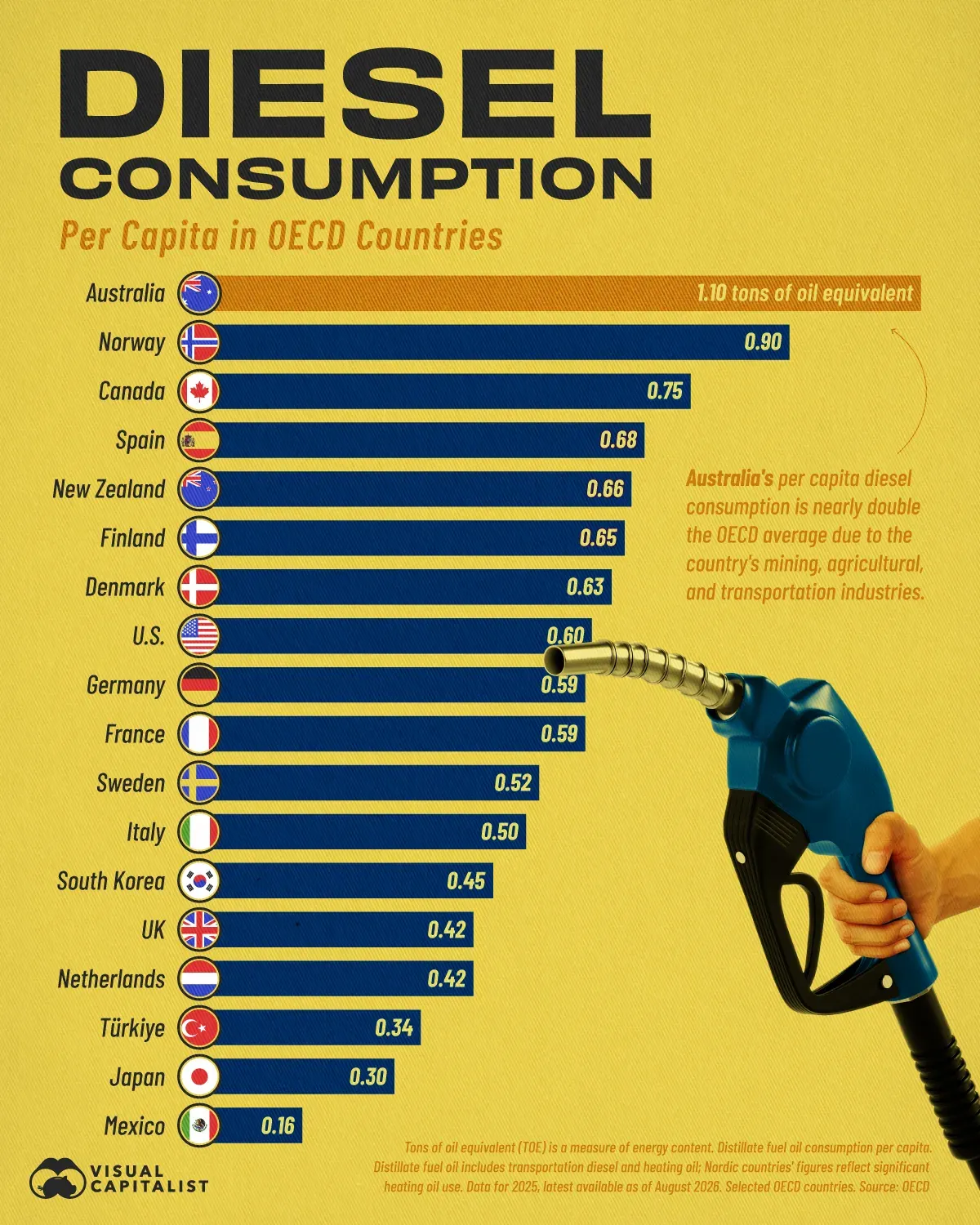
Another similarity between the two top-ranked countries is import dependency. Although Norway is one of the world’s leading crude oil producers, it depends on diesel imports because its only refinery lacks the capacity to meet domestic demand.
Sorry I was refering to the article above. I thought Norway has a sovereign fund that was worth billions. Why did they build such a small refinery.
A short history of the rate itself:
- Indexation to CPI was frozen in 2001 in response to public backlash over rising prices, locking the rate at 38.1 cpl for over a decade.
- CPI indexation resumed on 10 November 2014 under the Abbott government as a budget-repair measure, lifting the rate to 38.6 cpl and setting it on the twice-yearly (February/August) indexation path it still follows.
- By February 2022 the standard rate had climbed to 44.2 cpl.
- It was halved to 22.1 cpl from 30 March to 28 September 2022 (the Ukraine-shock cut), then restored to 46.0 cpl and continued indexing normally, reaching 52.6 cpl by early 2026.
- It was cut again in 2026 — effectively to 20.6 cpl (1 April–30 June), 36.6 cpl (1 July–2 August), before returning to a fully indexed 53.7 cpl from 3 August 2026.
Fuel excise is also charged before GST is applied — GST is calculated on the total pump price, excise included, which means Australians pay a 10% tax on top of a separate per-litre tax. This "tax on tax" structure has been criticised for decades and remains unchanged through every excise reform discussed above. Combined, excise plus GST typically make up somewhere between a third and a half of the pump price, with the exact proportion moving inversely with the international price — when Mogas 95 is cheap, tax is a bigger share of what you pay; when crude spikes, tax becomes proportionally smaller even though the flat per-litre rate hasn't changed. This is worth sitting with: fuel excise is genuinely one of the more efficient, low-distortion taxes an economist would recommend keeping, and it is also one of the most politically toxic, because motorists experience "tax" as a fixed grievance regardless of what share of the final price it actually represents. Fuel excise is also a serious line item for the Commonwealth — around $19.8 billion in 2024–25, the third-largest domestic tax stream after personal income tax and company tax, which is part of why every "temporary" cut has been genuinely temporary.
9. Cost-of-living and tax relief measures, beyond the headline excise cuts
- Fuel Tax Credits (FTC) — an ATO-administered scheme, unrelated to the temporary excise cuts, that refunds excise (in full or in part) to business users of fuel for off-road and certain on-road heavy-vehicle use. Rates are indexed twice yearly alongside excise, and they moved automatically with both the 2022 and 2026 excise reductions — meaning businesses saw less net benefit from the headline cuts than households did, since their fuel tax credit refund shrank in step with the excise rate falling. During the 2026 relief period, on-road heavy vehicle users saw close to zero net benefit once the Road User Charge and FTC changes were netted against the excise cut — the real relief for the freight sector came from the RUC suspension itself, not the excise cut.
- State/territory transparency schemes — WA's FuelWatch (2001), the NT's MyFuel NT, NSW's FuelCheck, Tasmania's FuelCheck TAS, and Queensland and Victoria's own state-run reporting frameworks all exist specifically to reduce the information asymmetry between retailers and motorists. None of them regulate the price itself; all of them are premised on the idea that if consumers can see and compare prices easily, competition will do the rest. The ACCC has repeatedly credited these schemes, and third-party apps built on the same data (PetrolSpy, MotorMouth, and others), with meaningfully improving consumer outcomes — around 41% of consumers reported using a fuel price app in 2024, up from 34% in 2022.
- Historical state fuel subsidies — Queensland ran a direct state government fuel subsidy for decades; it was removed on 1 July 2009 and has not returned, including during the 2026 crisis, despite Queensland posting the highest average prices of the five largest cities almost every quarter since.
- 2026-specific crisis measures — free public transport in Victoria and Tasmania (temporary, tied to the acute March–April 2026 spike); interest-free loans for freight and trucking operators from late April 2026; the strategic reserve drawdown; and the $4 million WA refinery feasibility study, alongside up to $1 billion in interest-free loans through the National Reconstruction Fund's Economic Resilience Program for manufacturing and logistics businesses in critical supply chains.
- What wasn't offered: unlike some cost-of-living packages in other portfolios (energy bill rebates, one-off payments), there has been no direct, means-tested fuel payment to households at either the 2022 or 2026 juncture — every measure so far has been a broad-based tax or charge reduction available equally to all fuel buyers, regardless of income or need.
10. Government hype versus actual effect
This is the part worth sitting with longest, because the pattern repeats almost exactly between 2022 and 2026.
Claim: the excise cut will meaningfully ease cost-of-living pressure. What happened: In both 2022 and 2026, the ACCC's own data shows retailers passed the cut through to the bowser quickly — largely vindicating the government's confidence that competition would do the job. But in both years, the underlying international price shock was larger than the tax relief, so nominal prices still hit record or near-record highs while the cut was in effect. The 2022 ACCC report is unusually candid about this: the cut "prevented even higher prices" but did not prevent a 14-year real-terms high. The excise cut did real work; it just wasn't the same work as "bringing prices down," which is how it was often reported and understood by the public.
Claim: this is a well-targeted cost-of-living measure. Independent assessment: Research cited by the Grattan Institute (drawing on work by e61) found that while lower-income households spend a higher proportion of their income on fuel, higher-income households spend more in absolute dollars — meaning a flat per-litre tax cut delivers more total dollars to wealthier, higher-fuel-consuming households than to the low-income households it's usually framed as protecting. Multiple economists, writing in The Conversation and cited separately in Victoria University's own coverage of the same research, went further: the 2026 cut was "smart politics but flawed policy," fiscally costly ($2.55 billion, on top of the earlier $1 billion a month cost of the 2022 cut), poorly targeted, and — worth noting given the RBA's separate 2026 rate decisions — created a structural "excise cliff" that mechanically pushed headline CPI back up the moment relief ended, complicating the same inflation fight the government was separately trying to win. The Grattan Institute's own follow-up piece pushed back on the harshest version of this critique, noting the cut also supported fuel-dependent businesses and could be implemented immediately, whereas better-targeted alternatives (direct payments, a windfall profits tax on gas exporters) would have taken longer to design and legislate. Both critiques were published by people with no stake in the policy's political success — which is precisely why they're more useful than either the government's or the opposition's own framing.
Claim: the Fuel Security Package (2020–21) would secure Australia against future shocks. What happened: The package succeeded on its narrowest terms — Geelong and Lytton are still operating, and the Minimum Stockholding Obligation existed and was drawn on in April 2026, exactly as designed. But the government's own 2020 language promised the package would "protect motorists from future higher prices" and "ensure Australia maintains a sovereign refining capability." By 2026, sovereign refining still covered under a fifth of national demand, and total fuel reserves — even after six years of the MSO being in force — sat at roughly 30 days of cover, a third of the International Energy Agency's 90-day benchmark for member countries. When the Iran war actually arrived, Australia was still, by its own government's admission, reliant on imported product arriving through the exact chokepoint (the Middle East, transiting via Asian refineries) that had just become the most contested piece of maritime geography on Earth. The July 2026 refinery feasibility announcement is itself a tacit acknowledgment that the 2020–21 fix didn't fully solve the underlying exposure — a genuinely new refinery hadn't been built in Australia since the 1960s, and the government is only now funding a feasibility study, not a refinery.
Claim (opposition, 2026): the excise cut alone isn't a fuel security strategy. Assessment: This is one of the few points where the Coalition opposition's criticism and independent economic commentary land in roughly the same place, even though they're arguing from different premises — the Coalition's critique was tied to broader energy and carbon-policy disagreements, while economists' critique was about fiscal targeting and inflation dynamics. Both agree, for different reasons, that a temporary tax cut is not, by itself, a durable answer to import dependence.
11. Ramifications
A few things follow from all of the above that are worth spelling out plainly:
- Australia's fuel price is now more exposed to Middle East geopolitics than at any point in at least two decades, purely as a function of the refining base having roughly halved between 2020 and 2021, right as the pandemic hit. This wasn't caused by COVID, but COVID-era demand collapse was the proximate trigger that made two already-marginal refineries commercially unviable.
- Fuel excise cuts are fast and effective as a delivery mechanism, but poor as a targeting mechanism, and both major uses of the tool (2022 and 2026) have created a predictable "cliff" effect on restoration that shows up directly in CPI data and complicates monetary policy — a genuine, if second-order, cost of using this particular lever.
- The gap between capital cities is structural, not incidental. Perth and Darwin's persistent price advantage traces directly to deliberate, decades-old state and territory transparency policy (FuelWatch, MyFuel NT) — a genuinely replicable model that Brisbane, in particular, has not adopted, and where the ACCC has explicitly found weaker competition is costing consumers money that has nothing to do with excise or crude prices.
- "Fuel security" has been a live, well-funded federal policy priority since at least 2020, and Australia was still short of its own stated benchmarks when the 2026 test arrived. That's not a partisan point — both the Morrison government's original 2020–21 package and the Albanese government's 2026 crisis response were framed in almost identical language ("keep Australia moving," "protect motorists," "sovereign capability"), and both were tested by real shocks (COVID/refinery closures, then the Iran war) that exposed the same underlying vulnerability: Australia imports the large majority of the fuel it burns, from a part of the world currently at war.
- Diesel, not petrol, has been the more strategically exposed fuel through 2026 — it hit a higher relative record (317.1 cpl versus petrol's 252.9 cpl) and remained further above pre-conflict levels for longer (71 cpl versus 37 cpl as of early August). Diesel underpins freight, agriculture and mining — sectors with far less ability to defer consumption than a household driver deciding whether to fill up this week or next — which means the economic bite of the 2026 shock likely lands harder on business input costs and, eventually, on the price of everything diesel touches to produce and transport, than the petrol headline figures alone suggest.
References
Primary regulatory and government sources
- ACCC — quarterly and weekly Petrol Price Monitoring Reports, 2019–2026 (accc.gov.au/by-industry/petrol-and-fuel)
- ACCC media releases on the 2022 and 2026 excise cuts, pass-through monitoring, and capital city price movements
- Australian Taxation Office — Excise duty rates for fuel and petroleum products; Fuel Tax Credit rates (ato.gov.au)
- Parliamentary Budget Office — "Fuel taxation in Australia" budget explainer, including Attachment A, "A brief history of fuel excise in Australia"
- Department of Infrastructure — Fact sheets on fuel excise relief measures, April and July 2026
- Prime Minister of Australia — media statements on the fuel excise cut, National Cabinet's National Fuel Security Plan, and the Karratha refinery feasibility study (pm.gov.au)
- Department of the Prime Minister and Cabinet — National Fuel Security Plan materials
- fuelplan.gov.au — official fuel statistics dashboard, 2026
- WA Department of Mines, Industry Regulation and Safety / Consumer Protection — FuelWatch scheme information and annual price analysis
- Congress.gov (Congressional Research Service) — "The Strait of Hormuz: Security Developments and Impacts on Oil, Gas, and Other Commodities"
Industry data
- Australian Institute of Petroleum — Terminal Gate Price data, "Facts About Petrol Prices and the Australian Fuel Market," International/Australian Market Snapshots (aip.com.au)
- CEIC / AIP — Weekly average petrol and diesel retail price series, 2019–2026
- Viva Energy Australia and Wikipedia (Geelong Oil Refinery) — April 2026 refinery fire timeline and production impact
Independent economic analysis
- Grattan Institute — "A fuel excise cut? It's not as bad as they say" (2026)
- The Conversation / Victoria University — "Halving the fuel excise is smart politics, but flawed policy" (2026)
- e61 Institute research on fuel spending by household income, as cited by Grattan Institute
- World Bank — April 2026 Commodity Markets Outlook, Strait of Hormuz oil price disruption analysis
- Federal Reserve Bank of Dallas — research note on Strait of Hormuz closure and global GDP impact
- Statista — Brent crude annual average price series, 1976–2025
News and trade reporting
- Al Jazeera, Bloomberg, SBS News, The Conversation, ABC News — reporting on the 2026 Iran conflict, fuel excise cuts, and Geelong refinery fire
- Stockhead, F&L Asia (Fuels & Lubes Asia) — Australian refinery closure history, 2020–2021
- Brookings Institution — "From chokepoint to crisis: The Strait of Hormuz and global oil markets"
- ACAPMAg (Australasian Convenience and Petroleum Marketers Association) — coverage of ACCC quarterly reports
- RAC WA — consumer guidance on FuelWatch and WA fuel pricing
Note on source reliability: political claims throughout this piece are attributed to the office making them (Prime Minister, Treasurer, opposition spokespeople, state ministers) rather than presented as neutral fact. Where commentary is drawn from bodies with no direct financial or electoral stake in the outcome — the ACCC as regulator, the Parliamentary Budget Office, the Grattan Institute, and academic economists writing in The Conversation — I've said so explicitly, since that's a meaningfully different kind of source to a government media release or an industry-funded explainer site.
So there you go. I found it interesting. Maybe I should of factored in the rise in EV's since China has deployed these at massive scale domestically, but I did not.
#enoughsaid